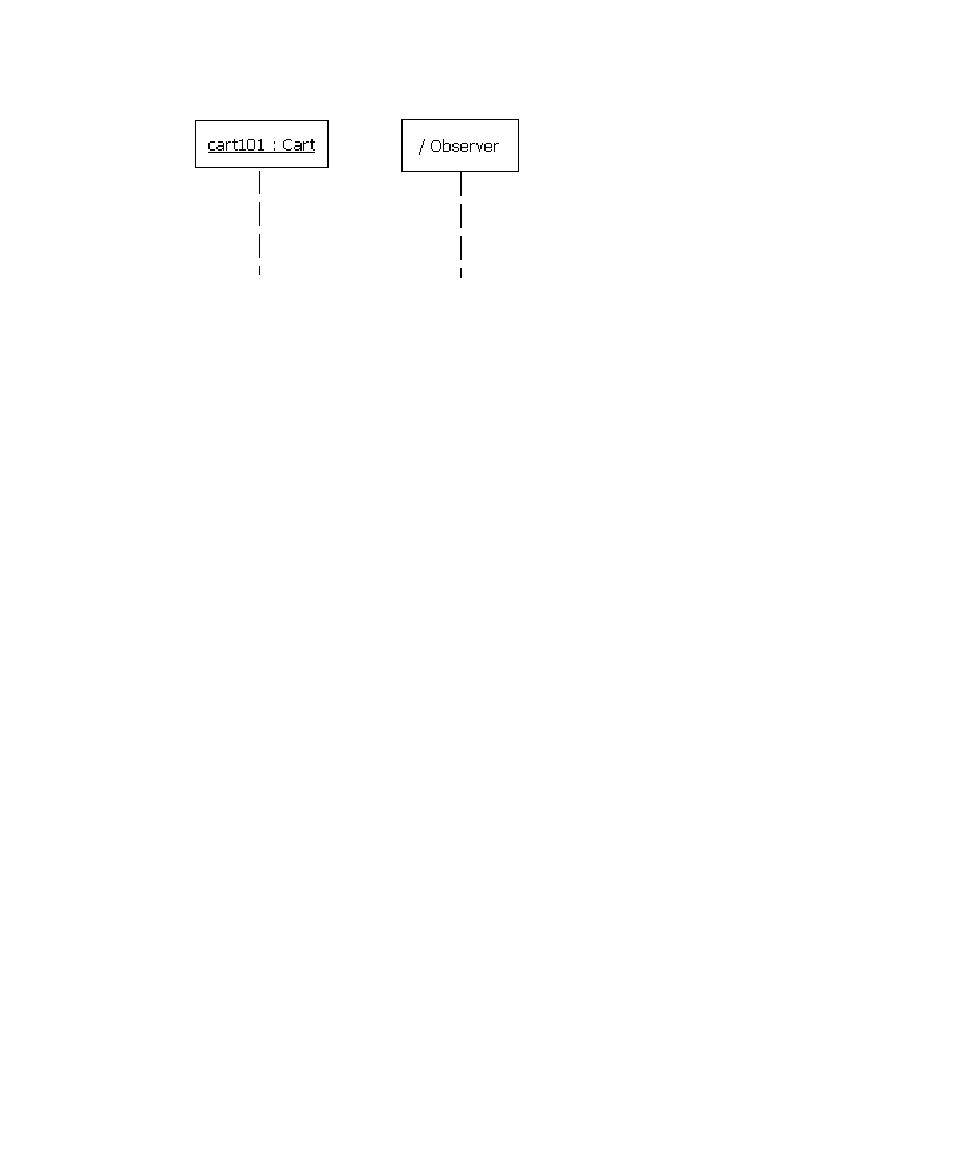

Using Lifelines
have a lifeline. Lifelines indicate the following:
level of the message or stimulus that creates it; otherwise, its lifeline starts at the
top of the diagram to indicate that it existed prior to the interaction.
arrows. A message or stimulus is drawn with its end on the lifeline of the
instance that sends it and its arrowhead on the lifeline of the instance that
receives it.
operation directly or through a subordinate operation) can be shown with
activations.
at the level of the message or stimulus that destroys it, and a destruction marker
appears; otherwise, its lifeline extends beyond the final message or stimulus to
indicate that it exists during the entire interaction.
Classifier Roles.
and usually indicates that an activity will follow. The types of communications that
messages model include calls to operations, signals to classifier roles, the creation of
classifier roles, and the destruction of classifier roles. The receipt of a message is an
instance of an event.
"Update" message to instances that are observing it. You can illustrate this behavior