Using Objects
Test RealTime - User Guide
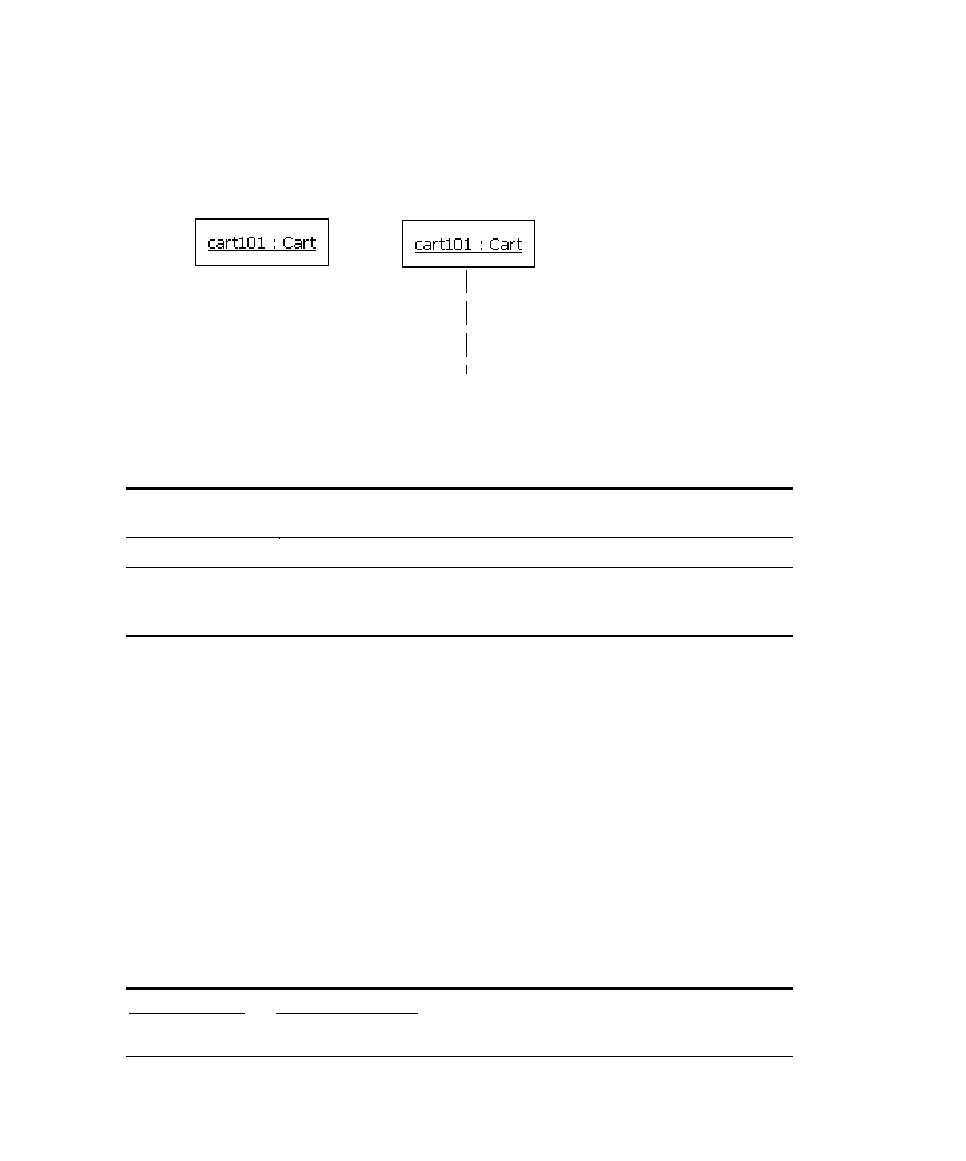
bottom of an object to represent the existence of the object over a period of time. For
details about lifelines, see Lifelines.
Object
Object with
Lifeline
Types of Objects
The following table identifies three types of objects.
Types of Objects
Description
Active
Owns a thread of control and may initiate control activity. Processes
and tasks are kinds of active objects.
Passive
Holds data, but does not initiate control.
Multiobject
Is a collections of object or multiple instances of the same class. It is
commonly used to show that a set of objects interacts with a single
stimulus.
Using Objects
Objects can appear in a sequence diagram to represent concrete and prototypical
instances. A concrete instance represents an actual person or thing in the real world.
For example, a concrete instances of a "Customer" class would represent an actual
customer. A prototypical instance represents an example person or thing. For
example, a prototypical instance of a "Customer" class would contain the data that a
typical customer would provide.
Naming Conventions
Each object must have a unique name. A full object name includes an object name,
role name, and class name. You may use any combination of these three parts of the
object name. The following table identifies the variations of object names.
Syntax
Example
Description
object/role:class
cart100/storage:cart
Named instance (cart100) of the cart class
that is playing the storage role during an
interaction.
16
