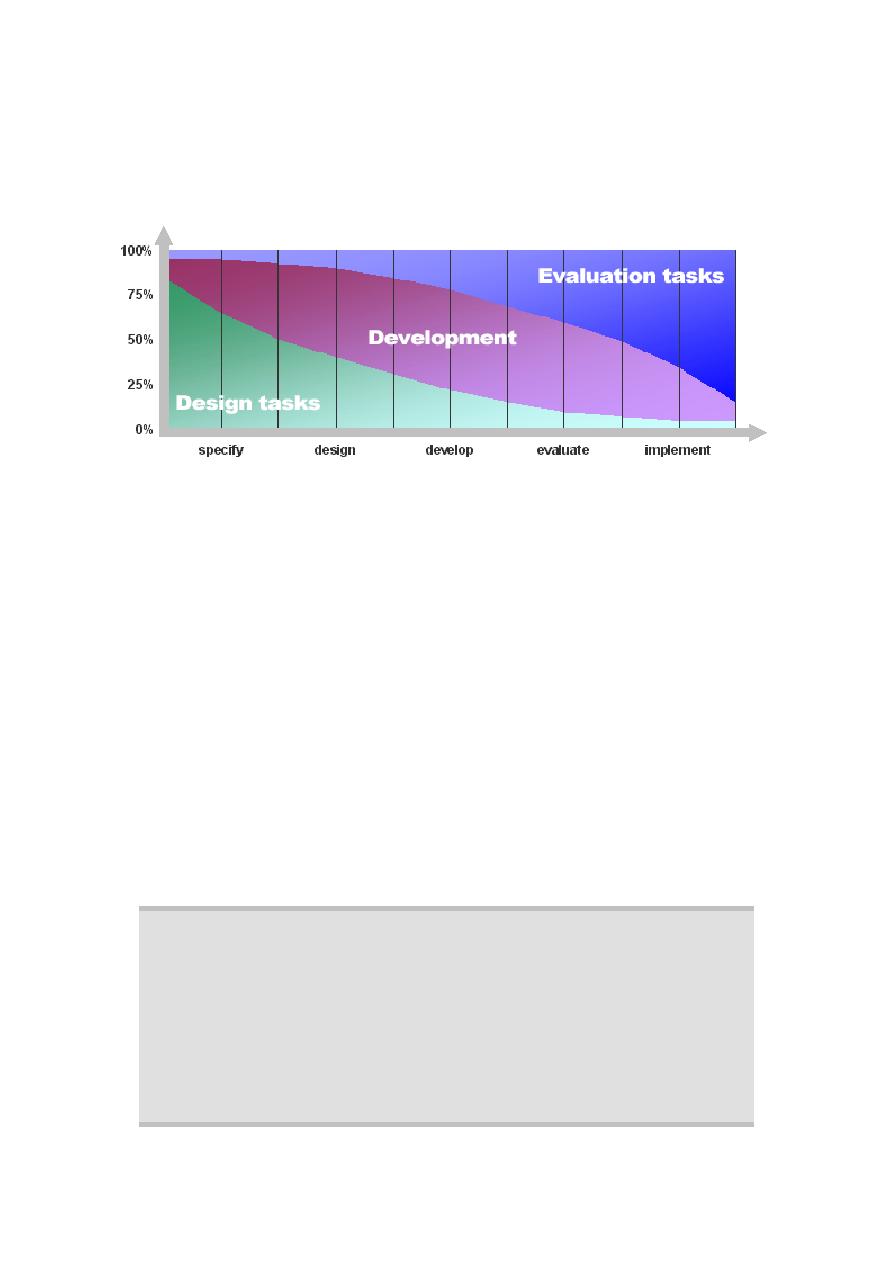
Incremental Development

necessarily focus on the same areas of functionality. It is better to deliver separate 'increments' of
functionality and assemble the whole project only at the conclusion of the production phase. This
way you can take partial steps towards your completed goal. Each unit can be individually
developed, tested and then bolted together to form the overall product or system.
incremental development. Early on the iterations focus on 'design tasks' and the emphasis is on
making design decisions and prototypes. As the project progresses tasks shift to development
where the bulk of the coding is done. Finally, the emphasis is on testing or evaluation to ensure
that what has been developed meets requirements and is solid, stable and bug free (ha!).
development models that focus on harnessing the creativity of software developers. They include
things like SCRUM, Extreme Programming and AUP.
their crashing failures and the overall performance of these techniques can be best described as
mediocre. A friend of mine summed it up best when he said, "They work really well if you have a
good team, but then anything works really well if you have a good team."
concepts mirror those from newer software development methodologies.
single development, in either technology or in management technique, that by itself promises even one order-
of-magnitude improvement in productivity, in reliability, in simplicity."