Isolation and Generalisation
Isolation and Generalisation
Isolation is the process of examining the causes of a defect.
While the exact root cause might not be determined it is important to try and separate the
symptoms of the problem from the cause. Isolating a defect is generally done by reproducing it
multiple times in different situations to get an understanding of how and when it occurs.
Generalisation is the process of understanding the broader impact of a defect.
Because developers reuse code elements throughout a program a defect present in one element
of code can manifest itself in other areas. A defect that is discovered as a minor issue in one area
of code might be a major issue in another area. Individuals logging defects should attempt to
extrapolate where else an issue might occur so that a developer will consider the full context of
the defect, not just a single isolated incident.
A defect report that is written without isolating and generalising it, is a half reported defect.
Severity
The importance of a defect is usually denoted as its "severity".
There are many schemes for assigning defect severity some complex, some simple.
Almost all feature "Severity-1" and "Severity-2" classifications which are commonly held to be
defects serious enough to delay completion of the project. Normally a project cannot be
completed with outstanding Severity-1 issues and only with limited Severity-2 issues.
Often problems occur with overly complex
classification schemes. Developers and testers get
into arguments about whether a defect is Sev-4 or
Sev-5 and time is wasted.
I therefore tend to favour a simpler scheme.
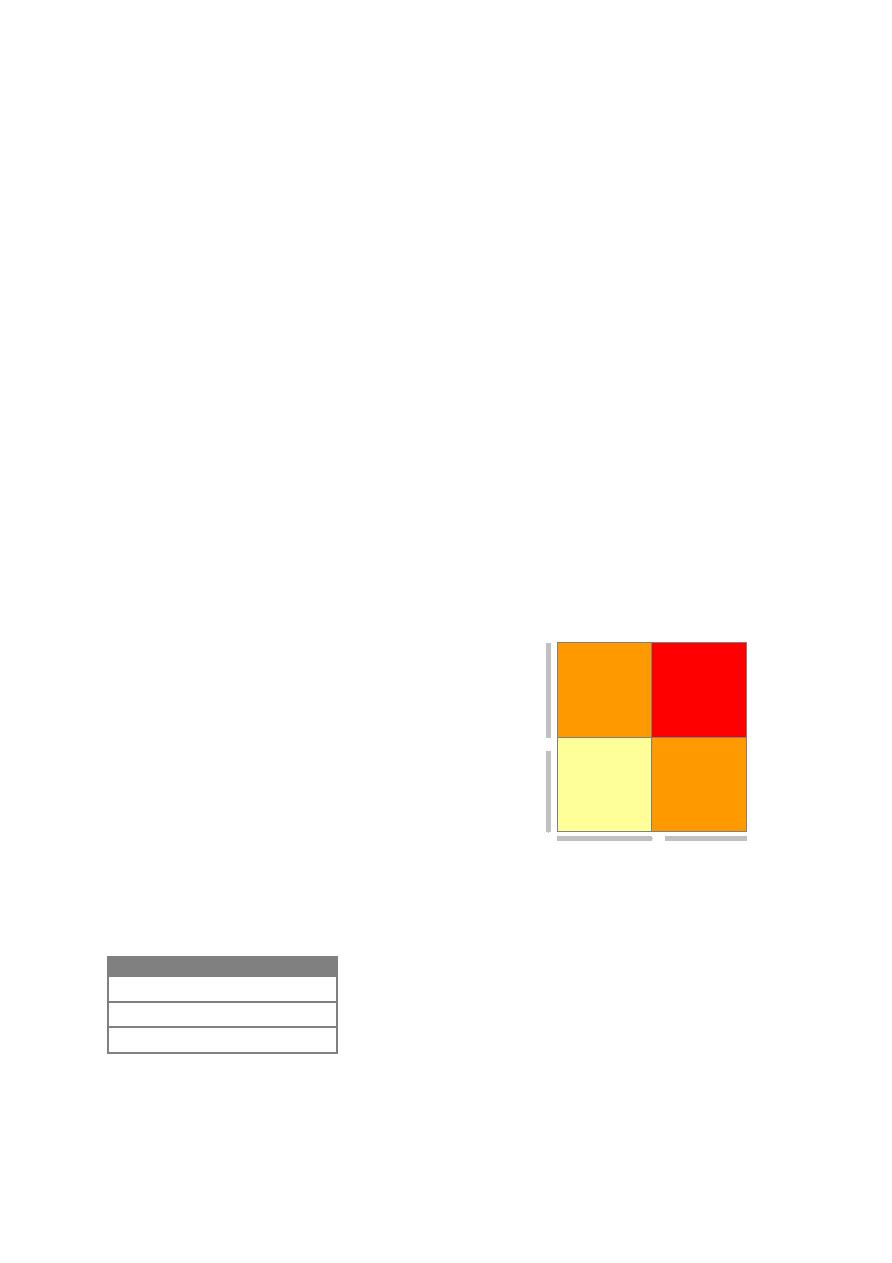
Defects should be assessed in terms of impact and
probability. Impact is a measure of the seriousness of
the defect when it occurs and can be classed as
"high" or "low" high impact implies that the user
cannot complete the task at hand, low impact implies
there is a workaround or it is a cosmetic error.
Probability is a measure of how likely the defect is to
occur and again is assigned either "Low" or "High".
Defects can then be assigned a severity based on :
Impact/Probability
= Severity
High / High
High
High / Low
Medium
Low / Low
Low
This removes the majority of debate in the assignment of severity.
31
Figure 10: Relative severity in defects
High
Low
High
Low
Medium
Medium
High
Low
Impact
Probability
